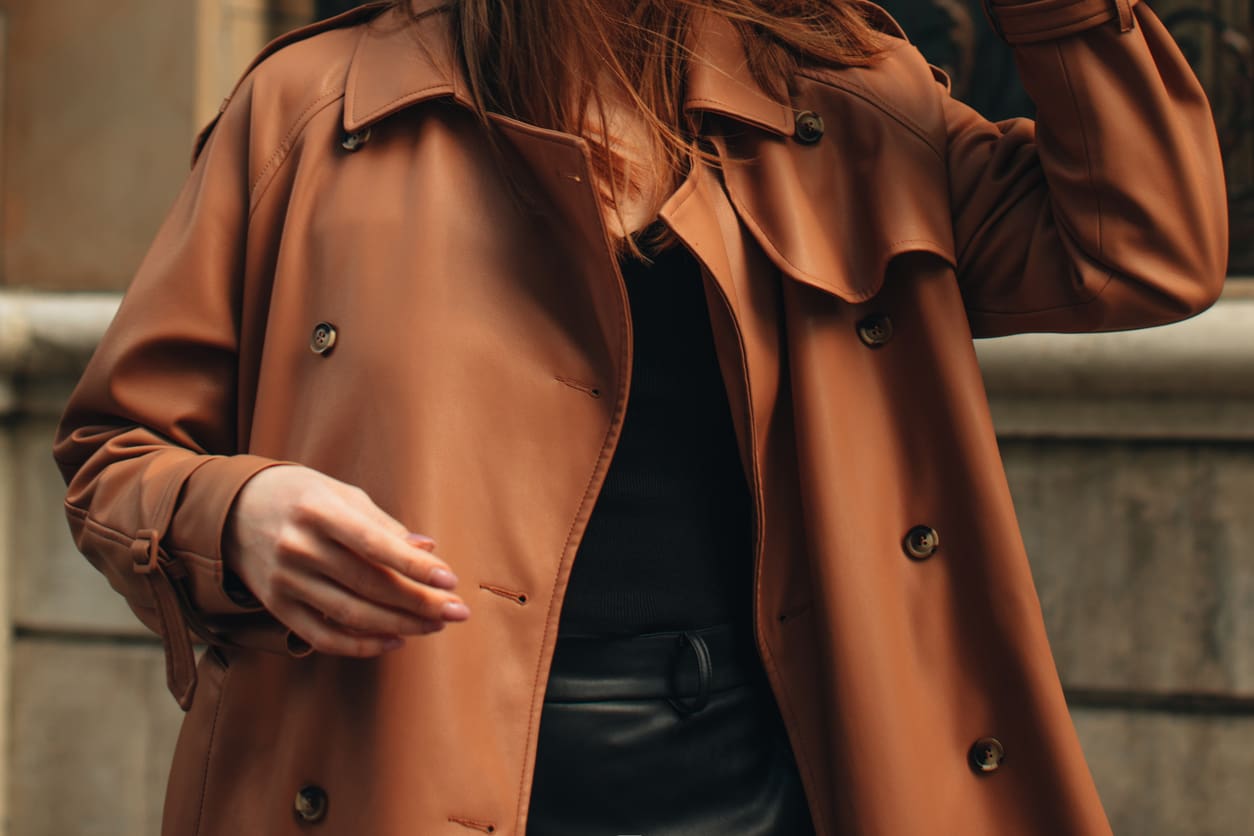
You wear your leather jacket, hang it up, and repeat. It looks fine from across the room, so you move on.
But here is what you could’ve missed: by the time damage is obvious, it has been building for months. Leather does not fail all at once. It warns you first with specific, checkable signs you can spot at home in under a minute.
Humid summers, cold dry winters, and sharp seasonal swings do not just affect how you wear it. They quietly accelerate wear whether your jacket is on your back or hanging in your closet.
Check these five signs today before maintenance turns into repair.
Sign 1 of 5 Early Stage
Healthy leather has visible depth. There is a subtle richness, a slight sheen, that comes from natural oils within the hide. When those oils deplete, that depth disappears. The surface looks flatter, lighter, sometimes almost gray compared to how it looked when you first wore it.
Take the jacket into natural light. Compare the collar and cuffs (highest wear) to the back panel or interior (lowest wear). A noticeable difference in color depth or sheen between those areas is uneven oil depletion and it is your earliest warning.
What Dullness Actually Signals Underneath
Dullness is not a cosmetic issue. It is the first stage in a sequence:
Catching it at stage one costs significantly less than catching it at stage three. If the jacket came out of summer storage looking flatter than it went in, heat and low humidity during storage likely accelerated oil evaporation even while the jacket was hanging there.
Sign 2 of 5 Act Soon
The collar and cuffs work harder than any other part of the jacket. They flex constantly during wear, absorb perspiration and skin oils, and take the most mechanical stress over time.
Fold the collar back and forth gently. Healthy leather moves without resistance. If you feel stiffness or hear a faint crackling sound as it flexes, that is the fiber structure under stress. The crackling sound is the clearest signal you are right at the edge between stiff and cracked.
Stiffness is the last recoverable stage before cracking begins. Professional leather and suede cleaning at this point can restore suppleness and stop the progression.
Once fold lines start to crack at the elbow creases, collar folds, and underarm areas, those are structural tears. They can be partially treated but not reversed. Conditioning and professional cleaning at the stiff stage restores the jacket. At the cracking stage, repair is the only option, and repair is not the same as restoration.
Sign 3 of 5 Act Soon
Leather holds onto smells in a way fabric does not. Body perspiration, smoke, dampness from rain, cooking odors – they absorb into the hide itself, not just the surface. And unlike fabric, leather cannot simply be washed.
Hang the jacket outdoors or in fresh air for a full day, away from other fabrics. Then smell the collar and interior lining closely. If there is still a musty, sour, or persistent odor after a full airing-out, the source is embedded in the leather itself, not sitting on top of it.
This is where a lot of people waste time and money:
The odor is not the only issue. The body oils and perspiration causing that smell actively degrade the leather surface over time. It is a maintenance signal, not just an annoyance.
Sign 4 of 5 Act Soon
Those faint white or grayish marks that show up after the jacket gets wet are salt lines. They are one of the most misunderstood signs of damage and one of the most harmful if left alone.
What is actually happening: when leather gets wet, moisture pulls dissolved salts from within the hide to the surface. As the moisture evaporates, the salts stay behind as a visible haze, often following the exact boundary of where the jacket got wet.
In direct light, examine the shoulders, collar, and cuffs closely after any rain exposure. A white residue at the base of the collar from perspiration counts, too. Faint haze marks in those areas mean salt is accumulating with each wear cycle.
Salt is hygroscopic, meaning it continues to draw moisture from the surrounding leather as it sits, drying out the area around each deposit. Rubbing at the marks with a dry cloth spreads the deposits and pushes them deeper into the surface, making professional treatment harder. If you have already tried to wipe them away, that is not a reason to wait. It is a reason to move faster.
Salt deposits left across multiple seasonal cycles accumulate and compound. What starts as a faint haze after one rainy day becomes concentrated, abrasive damage to the leather grain over a full season of wear.
Sign 5 of 5 Immediate Care Required
This is the most serious sign on the list. If this is what you see, act now.
Fine hairline cracks at the elbow creases, collar folds, and underarm areas are caused by the leather fiber tearing as it flexes without adequate lubrication. The oil content has been depleted to the point where the fiber structure itself is failing at points of repeated mechanical stress. Flaking of the surface finish means the outer coating is detaching from the hide beneath it.
Bend the elbow areas and collar into a natural flex position. Look closely at the fold lines in direct light. Hairline cracks, even very fine cracks, appear as irregular lines running across the flex point. Any flaking or peeling of the surface finish is immediately visible.
At this stage, conditioning can slow or halt further cracking in adjacent areas. Leather repair products can partially fill and treat existing surface cracks. Full reversal of deep or extensive cracking is not possible. The longer this sign is left untreated, the more of the jacket's surface is at risk.
Leather care is not the same everywhere. Geneva's climate creates a specific pattern of stress that cycles through all four seasons, and every stage of that cycle does something different to hide.
| Season | What It Does to Leather | Which Sign to Watch For |
|---|---|---|
| Summer | High humidity and heat accelerate oil evaporation, even in storage. Leather can lose conditioning faster than during any other season. | Dullness (Sign 1) is the first thing to appear after a hot summer. |
| Fall | Temperature swings begin drying the surface. The jacket rapidly transitions from humid-wear conditions to dry-air conditions. | Stiffness (Sign 2) typically develops through fall as oil loss compounds. |
| Winter | Cold dry air and indoor heating strip residual moisture from the hide continuously. The hide dries from the inside out. | Salt lines (Sign 4) accumulate through winter. Cracking (Sign 5) develops if conditioning was skipped in fall. |
| Spring | The damage from winter becomes visible. Jackets that were not maintained through the cold months show cracking along fold lines in March and April. | Cracking (Sign 5) is most commonly discovered at this point. |
A leather jacket worn through all four seasons in Geneva needs consistent care. One professional cleaning per year, timed before or after storage, keeps all five signs on this list from progressing. Once any of them reaches stage five, maintenance is no longer the conversation.
If you spotted even one of these signs, your jacket is already telling you something. Dullness, stiffness, embedded odor, salt lines, or surface cracking – each stage moves faster than most people expect, especially after a Geneva winter.
At Geneva Cleaners, leather and suede are not treated like everyday garments, because they are not. We restore fine outerwear to like-new condition by: gently raising the nap on suede, reapplying high gloss on black leather, and bringing faded dyes back to their original luster.
Your jacket has made it this far. Bring it in and let us take it from here.
Address: 130 W. State St., Geneva, IL, 60134
Phone: +1 331-322-0179
Email: customerservice@genevacleaners.com
Hours: Mon through Fri: 7:00 AM to 7:00 PM | Sat: 8:00 AM to 4:00 PM | Sun: Closed