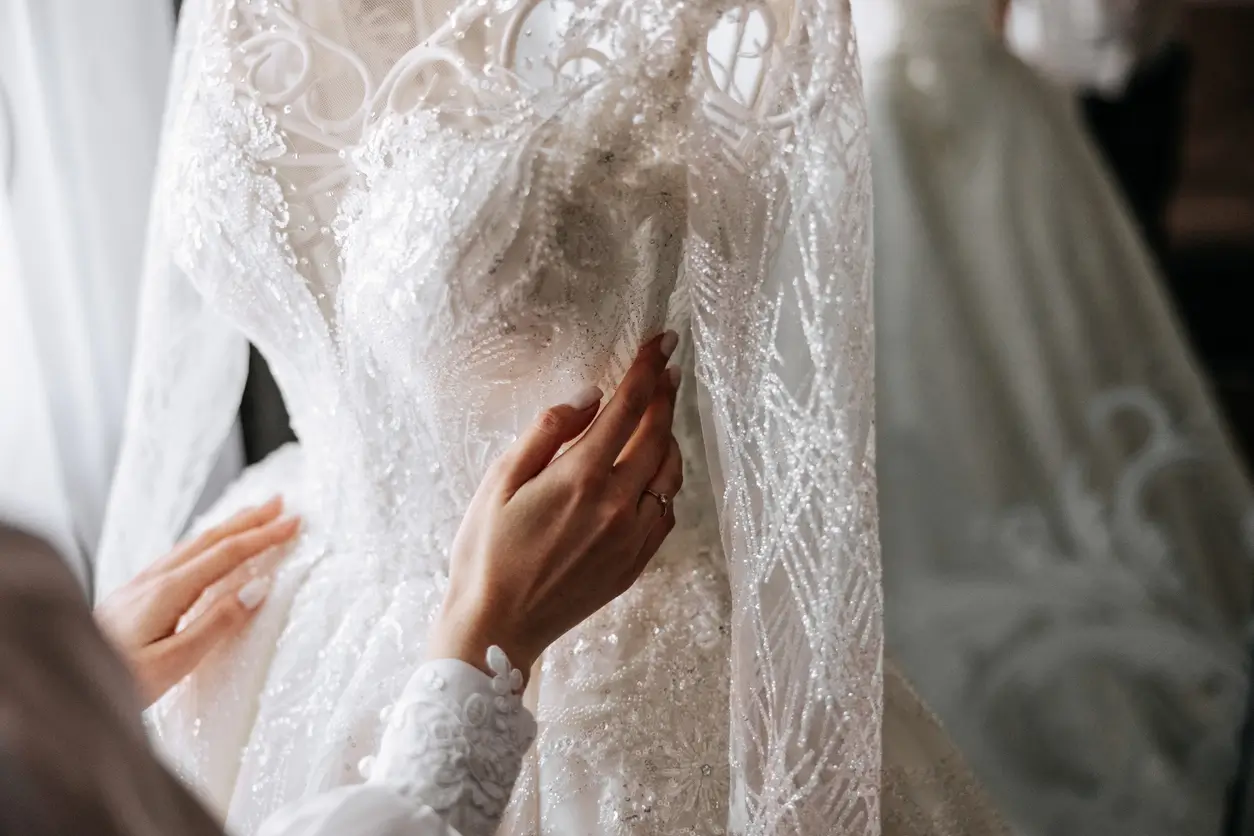
Your wedding dress carries more weight than almost anything else in your closet, not because of what it costs, but because of what it represents. Store it properly, and it can be handed down for generations. Store it the wrong way, and it quietly deteriorates without you ever noticing until the damage is done.
Properly preserving a wedding dress comes down to a specific set of standards most cleaning services never mention. This guide covers what actually damages your dress in storage, what true preservation requires, and how to separate a service that meets that standard from one that only claims to meet it.
Nothing else in your closet gets worn once, photographed hundreds of times, then packed away for decades without a single wash. That alone makes a wedding dress one of the most fragile items you'll ever own.
Most clothes get regular wear and cleaning. A wedding dress gets one day of heavy use – champagne, dance floors, grass, hours of body heat – then goes straight into a box and stays sealed until it's too late to reverse.
The materials in a wedding dress behave nothing like a cotton T-shirt or a wool coat.
A dress isn't one material. It's several, aging at different speeds, which is why generic garment care can't protect it the way it protects a suit or a coat.
Damage to a stored dress rarely happens all at once. It builds quietly, through small chemical and environmental shifts that compound over years.
None of this looks dramatic at the moment. A dress that goes into storage looking pristine can come out a decade later showing every one of these effects at once, simply because none of them was ever addressed.
Humidity and light don't damage a dress independently. They compound each other: moisture makes fabric more reactive to UV light, and UV exposure makes fibers more porous and likelier to absorb moisture. That's why closet storage, even in a nice closet, is rarely neutral, since most homes have some light leakage and seasonal humidity changes.
One of the most misunderstood risks to a stored dress is invisible at the time it happens. Champagne, cake frosting, sweat, and even perspiration leave residue that doesn't show up under normal light right away. Over time, it oxidizes and slowly turns pale yellow or amber, usually right where you'd expect: underarms, the hem, anywhere fabric brushed skin or spilled drinks.
By the time it shows, it has already set into the fibers, making it far harder to remove than it would have been right after the wedding.
Sugar-based residue is chemically different from a visible stain like wine or grass. It has no pigment of its own, and the yellowing is an oxidation reaction, similar to how a cut apple browns in the air.
That reaction can take months or years to surface, so a dress that looks spotless going into storage may already carry the residue that discolors it later. That's why professional preservation treats a dress as though invisible residue is present, rather than judging it by how it looks under a lamp.
In the garment care industry, there's a real difference between a service that cleans and boxes a dress and one that actually preserves it. Both may use the word preservation, but they're not the same process. Professional preservation starts with carefully inspecting the gown and selecting an appropriate cleaning method based on its fabrics, construction, care label, stains, and decorative trims.
The goal isn't just visible cleanliness. It's removing the invisible residues without stressing the weakest parts of the dress.
If a service only offers to clean and box your dress without describing the storage materials used, it's worth asking directly if it meets an archival standard or just looks like it.
The materials used to store a wedding dress after cleaning are an important part of long-term preservation. Acid-free and archival-quality materials can help protect delicate fabrics while the gown is in storage.
Ordinary tissue contains lignin, which breaks down into acidic byproducts over time, the same process that turns old newspaper yellow and brittle. Plastic traps whatever moisture is present at sealing since it doesn't let fabric breathe.
Careful handling at home matters, but care alone can't replace materials and processes that only exist in a professional setting.
Handling the dress gently at home is a good instinct, but it only addresses the risks you can see. The risks that actually damage a dress over time are chemical and environmental, not physical, and no amount of careful folding stops oxidation already at work in the fibers.
How soon to preserve a wedding dress after the wedding itself is a fair question, and there's no need for panic if your wedding was months ago and the dress is still in its garment bag. But there is a real, practical reason sooner is better than later, and it has nothing to do with manufactured urgency.
The residues discussed earlier – sugar, oils, and other invisible substances – get harder to remove the longer they sit. Over time, they set deeper into the fibers, and the oxidation behind the yellowing progresses further, which can mean the difference between a treatment that fully restores the fabric and one that only partially does.
If it's been a year, five years, or longer since the wedding, preservation is still worth pursuing. A reputable preservationist will give you an honest assessment of the condition of the dress rather than promising the same result no matter how long it's waited.
Not every service offering wedding dress preservation works to the same standard, so a few direct questions can tell you a lot before you hand over the dress.
Proper preservation gives a dress the best chance at long-term stability, but where you store the finished box afterwards still matters.
At Geneva Cleaners, a third-generation family business with more than 70 years of experience caring for delicate garments, we treat every wedding dress preservation the way a museum would treat it, starting with an honest assessment and using only archival-standard materials for a result built to last generations. Geneva, Illinois brides trust us to build a restoration plan around the actual condition of their dress, not a one-size-fits-all package.
Ready to give your dress the care it deserves? Call to book your free wedding dress consultation, reach us by email, or stop by the shop. We'd love to help you protect your dress for good.
Phone: +1 331 294 8167
Address: 130 W State St., Geneva, IL 60134